
The question of alternating barefoot shoes and conventional shoes is one of the most frequent topics when choosing children's footwear. It is not a fashion trend or an extreme approach to footwear. It is about the function of the child's foot, its development, and how footwear influences it in everyday life.
A child's foot is not born fully formed. The arch forms gradually, muscles learn to work through movement, and stability is created only through use. The role of a shoe is not to shape or fix the foot, but to not hinder its natural development. This is where a fundamental question arises: what happens if a child alternates between two fundamentally different types of footwear?
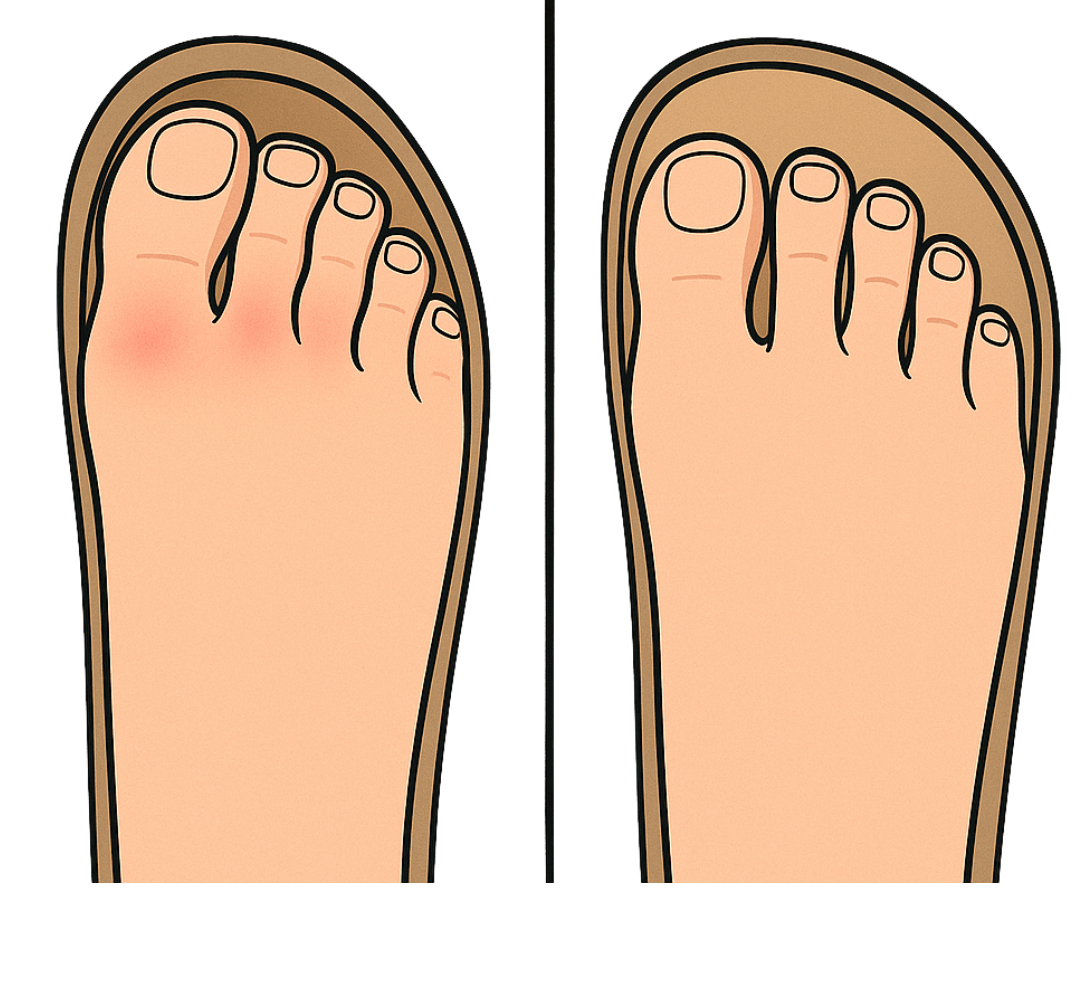
Why alternating can work (only under certain conditions)
A child's foot needs space, movement, and the possibility of active work. Footwear that respects the shape of the foot allows for the involvement of the foot muscles and natural stability.
Therefore, it is essential to monitor whether the shoe supports the foot or restricts it.
- Alternating with conventional shoes can only work if the conventional shoe does not change the shape of the foot. However, practice shows that most conventional shoes have a narrow cut, a reinforced heel, and a hard sole, thereby taking away the foot's freedom of movement
Why alternating often does not work
- If a child transitions from footwear that allows natural movement to shoes that squeeze the toes together, turn the foot into a "flipper," and fix the ankle, the foot receives conflicting signals. At one moment it has freedom, at another it is restricted. This can lead to reduced stability, changes in movement patterns, and muscle weakness.
- Children with "flipper-shaped" feet, a narrow heel, and a narrow ankle are particularly sensitive to conventional footwear. It is precisely in their case that it often turns out that a conventional shoe does not respect the shape of the foot, even if it is labeled as "medical" or "orthopedic."
It is also important to realize one fundamental thing: a child cannot objectively judge whether footwear is suitable for their foot. A child gets used to it – to the pressure, to the tight space, and to the restricted movement. The statement "I walk well in these" often means only adaptation, not respect for the foot's needs.
What parents should look out for
- shoe shape and sufficient space for toes
- shoe behavior during walking (flexibility, stability)
- whether the footwear does not change the natural movement of the foot
What is important to know
- not every firm shoe is healthy for a child's foot
- a child's foot does not need fixation, but space
- the greatest risk is not the type of footwear, but shoes that do not fit
- alternating different types of footwear is not the main problem
The real problem arises when one type of shoe allows the foot natural movement and the other restricts it in the long term
A child's foot always adapts. The question remains: what do we let it adapt to. Shoes should not change the shape of a child's foot. They should adapt to its shape. And that is where the difference that matters begins.